

What Does Modularization Really Deliver?
2026-11-02

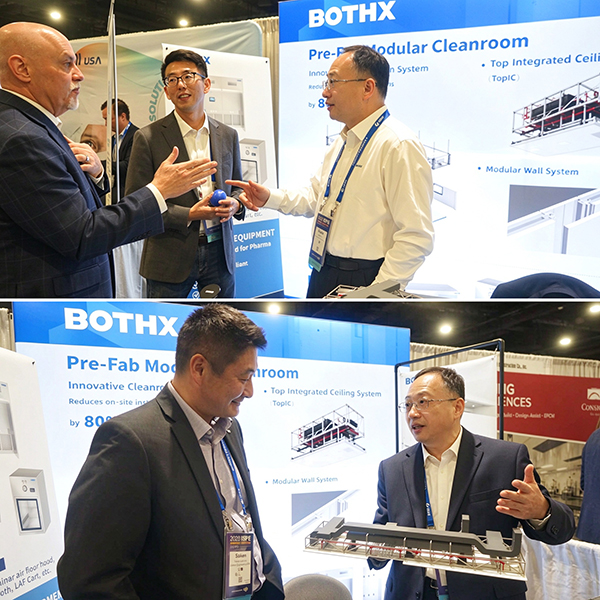
From October 19 to 21, BOTHX participated in the 2026 ISPE Annual Meeting & EXPO in Washington, D.C., USA, showcasing modular MEP solutions, including prefabricated integrated ceiling systems. The event provided an opportunity to engage with experts in the life sciences and biopharmaceutical industries on production facility requirements and project delivery practices.
Discussions went beyond simply identifying which components could be prefabricated as modules. They extended to critical considerations such as clear height, structural loading, fire protection, MEP capacity, and maintenance access. Although these issues fall under different engineering disciplines, they all point to one central question: How can coordination across design, manufacturing, and onsite execution ensure that a facility meets process and operational requirements and is delivered as intended?This is what clients ultimately care about. Completing modules in a factory is not merely a change in construction methodology. It requires coordinated efforts across design, manufacturing, and onsite implementation to deliver facilities that meet both process and operational needs.
Defining Prefabrication Boundaries Based on Actual Project Requirements
For life sciences facilities, delivery methods should be evaluated not only in terms of construction efficiency, but also their impact on subsequent operation and maintenance. Moving work into a factory changes where it is performed.Only by reorganizing the relationship between design, manufacturing, and onsite activities can overall project delivery be improved.
BOTHX's Integrated Hybrid Facility (IHF) solution emphasizes the right balance between factory prefabrication and onsite execution. Based on process workflows, spatial layouts, system configurations, operation and maintenance requirements, and site constraints, the scope of prefabrication is determined so that suitable work can be integrated in advance at the factory and coordinated with onsite construction. The question is not how much can be prefabricated, but whether prefabrication can reduce trade interference and rework, prevent interface issues from carrying over into subsequent stages, and support the facility's long-term operational requirements.
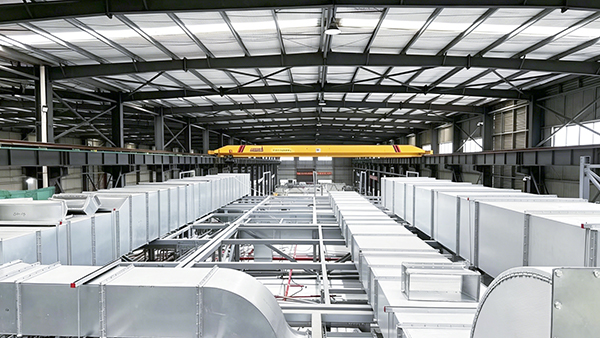
Take prefabricated integrated ceilings as an example. Depending on project requirements, HVAC ductwork, fire protection piping, electrical cable trays, and lighting systems can be coordinated and integrated in the design, then prefabricated in a factory environment. This helps reduce overhead installation work and onsite clashes between multiple trades. Achieving this requires earlier coordination of utility routing, equipment interfaces, maintenance access, and installation conditions, ensuring that factory manufacturing and onsite execution follow a consistent design basis.Less work onsite does not mean less coordination. It means coordination must happen earlier and more thoroughly.
From Factory Manufacturing to Complete Project Delivery
A controlled factory environment provides favorable conditions for repetitive manufacturing, process inspections, and selected functional tests. However, a module passing factory inspection does not automatically mean the entire facility meets its requirements. The condition of modules after transportation, the quality of onsite connections, and compatibility with other facility systems must still be inspected and verified. Factory testing and onsite commissioning have distinct scopes and cannot replace one another.
Complete modular delivery requires all stages to form a closed-loop process: design revisions, interface documentation, and inspection records must remain consistent and traceable; manufacturing and installation responsibilities must be clearly defined; and any deviations identified during testing must be corrected and retested. For overseas projects, local codes, permitting requirements, and acceptance criteria must also be incorporated into the solution assessment at an early stage. Responsibilities and interfaces should be clearly established with local design partners, general contractors, and specialist installation teams to ensure effective coordination between factory manufacturing and local project execution.
With cleanroom system integration at its core, BOTH connects detailed engineering, project execution, and equipment interfaces. Our focus goes beyond whether individual activities are completed to ensuring that production requirements are accurately translated into site implementation.
Drawing on BOTH's experience in cleanroom system integration and BOTHX's manufacturing capabilities, BOTHX combines modular design expertise and system integration experience to define appropriate prefabrication scopes and engineering interfaces. Its manufacturing capabilities support fabrication and process inspections, while collaboration with local engineering resources helps connect prefabricated components with onsite installation and commissioning. This approach enables factory-prefabricated work to become fully integrated facilities that meet actual project requirements.
Ultimately, modularization is not about achieving a higher prefabrication ratio or delivering a batch of factory-inspected products. It is about delivering a facility that meets agreed operational requirements, enables efficient and controlled onsite execution, and has its quality and operating conditions verified through inspection and testing.This is also the core of BOTHX's modular delivery model.